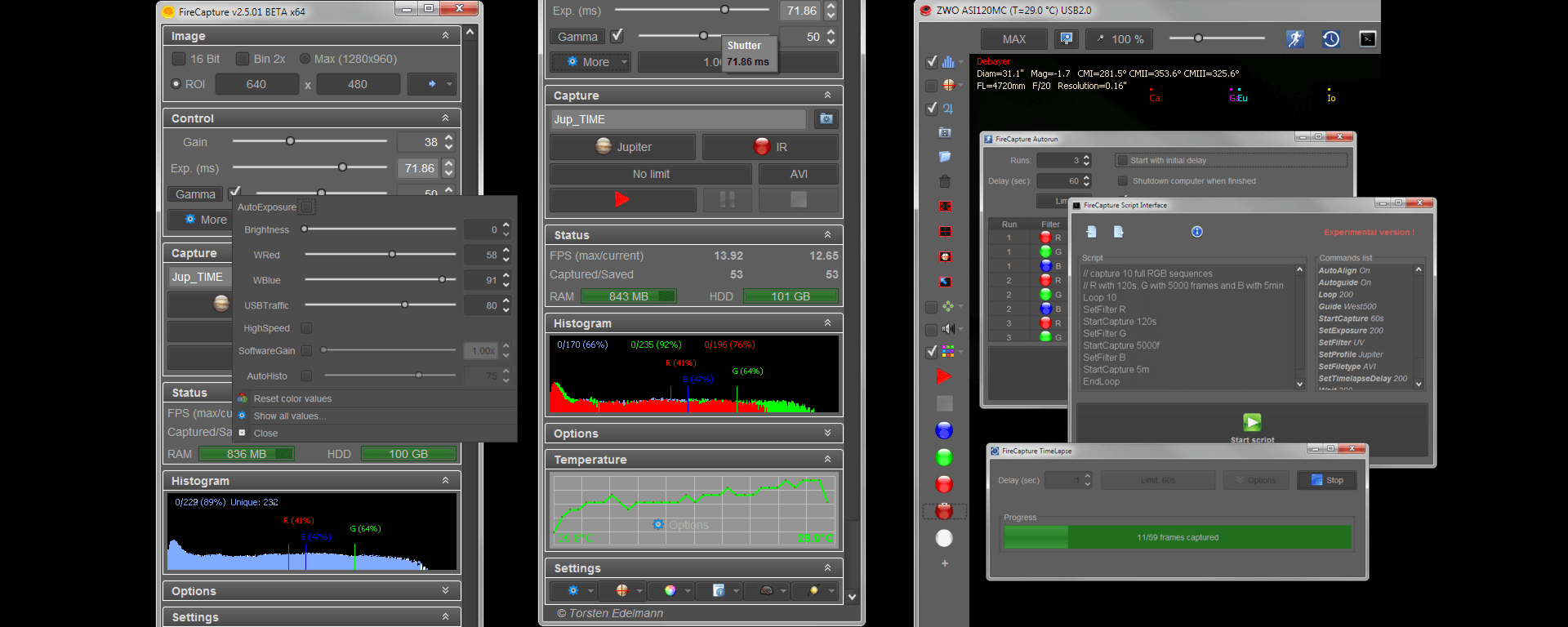
Raspberry support for FireCapture v2.6 and ZWO cameras !
| Compatibility |  FC v2.7.15 (x64) |
 FC v2.7.15 (x64) |
 FC v2.7.15 (x64) |
FC v2.7.15 (aarch64) |
|
|---|---|---|---|---|---|
 Altair Altair |
 |
 |
|
|
|
 ASCOM ASCOM |
 |
|
|||
 Basler Basler |
|
|
|||
 FLIR/FlyCap FLIR/FlyCap |
 |
|
|||
| FLIR/Spinnaker |
|
|
|||
 LUCID LUCID |
|
|
|||
 NexImage NexImage |
|
|
|||
 OGMA OGMA |
|
|
|
|
|
 PlayerOne PlayerOne |
|
|
|
|
|
 QHY QHY |
|
|
|
|
|
 Skyris Skyris |
|
|
|||
 SVBony SVBony |
|
|
|
|
|
 TIS
TIS |
|
|
|||
 Touptek/Omegon Touptek/Omegon |
|
|
|
|
|
 ZWO ASI ZWO ASI |
 |
|
|
|
|
Older Versions
Developing software is mostly fun, but it also takes up nearly all of my spare time. If you find FireCapture useful and would like to support me in continuing development you're welcome to donate a small amount of your choice.


: While actresses aged 22–31 receive the most female dialogue (38%), women aged 45–65 receive only of dialogue, whereas men in that same age range hold nearly of speaking time. Award Recognition
When we celebrate mature women in cinema, we move away from the "ingenue" trope and toward a richer, more diverse storytelling landscape. We acknowledge that a woman’s story doesn’t end when she stops being a "love interest"—in many ways, that’s exactly where the most interesting chapters begin.
Despite these challenges, the narrative is shifting as mature women demand—and receive—more multi-layered roles. Women Over 50: The Right to be Seen on Screen
The 1990s and early 2000s were particularly brutal. The rise of the "frat pack" comedies and high-octane action heroes left little room for women over 40, unless they were playing the shrill wife. Research from San Diego State University’s Center for the Study of Women in Television and Film consistently showed that older actresses received fewer lines and less screen time than their male counterparts. The industry operated on a toxic arithmetic:
Culturally, the perception of attractive mothers reflects broader discussions on feminism and gender equality. It questions traditional power dynamics and stereotypes, promoting a more inclusive understanding of women's roles and identities in society.
: While actresses aged 22–31 receive the most female dialogue (38%), women aged 45–65 receive only of dialogue, whereas men in that same age range hold nearly of speaking time. Award Recognition
When we celebrate mature women in cinema, we move away from the "ingenue" trope and toward a richer, more diverse storytelling landscape. We acknowledge that a woman’s story doesn’t end when she stops being a "love interest"—in many ways, that’s exactly where the most interesting chapters begin.
Despite these challenges, the narrative is shifting as mature women demand—and receive—more multi-layered roles. Women Over 50: The Right to be Seen on Screen
The 1990s and early 2000s were particularly brutal. The rise of the "frat pack" comedies and high-octane action heroes left little room for women over 40, unless they were playing the shrill wife. Research from San Diego State University’s Center for the Study of Women in Television and Film consistently showed that older actresses received fewer lines and less screen time than their male counterparts. The industry operated on a toxic arithmetic:
Culturally, the perception of attractive mothers reflects broader discussions on feminism and gender equality. It questions traditional power dynamics and stereotypes, promoting a more inclusive understanding of women's roles and identities in society.
It was back in 2008 when I got hold of a SONY newsletter announcing a new CCD sensor (ICX618) which promised fantastic sensitivity. Still working with an old webcam those days I instantly had the idea of replacing the webcam sensor with the new SONY sensor. It took weeks and dozens of emails to get the confidential spec of the new sensor. When I saw the sensitivity values it was clear: I had to have this sensor! The Basler Scout scA640 was the first machine vision camera on the market using this sensor and when I bought it the nightmare began: the included software was useless for planetary imaging and running the camera with the VRecord webcam tool was a complete PITA. Bugged by the inability to store even the basic camera settings I decided developing my own capture software.
What started as a solely private project soon turned into higher gear when fellow astronomers saw the software and insisted on getting it. I decided to make it public, included new camera interfaces and after years of continuous development FireCapture has evolved to one of the leading planetary capture tools. Developing the thing is only one part of the story: with a supportive community of users behind me I always had the feeling of someone 'looking over my shoulder' during the countless hours of programming. I can't mention all but just want to say:
Thank you guys !